

How to block ads on Safari – macOS and iOS [2025]
What we learned sending a team pack to people in five different countries

Blockzilla is built by a small team. Not small in ambition - small in headcount, and spread across Europe. The kind of setup where most communication happens in writing, meetings are scheduled around time zones, and the closest thing to a shared office is a group chat. It works. But it also means that the things that naturally build team culture in a co-located setting - the shared lunch, the whiteboard session, the incidental conversations - simply do not happen. At some point we asked ourselves: what could we actually do that would feel like more than another digital touchpoint?
Why we stopped waiting for the right moment
There is always a reason to delay something like this. The product is not big enough yet. The team might change. It feels premature. But those reasons do not go away - they just get replaced by different ones. We decided to stop treating a team pack as something that made sense only at a certain scale, and just do it.
The trigger was a new team member joining. It felt like the right moment to mark it with something real rather than a welcome message and a list of tools to install.
A product built by people in different time zones
The logistical challenge was the same one that stops a lot of small distributed teams from doing this at all. The team is spread across multiple European countries. There is no warehouse, no office address to send a bulk shipment to, no one person who could receive everything and then re-distribute it. Every solution that started with "we could just..." quickly became more complicated than it looked.
What we needed was a single order that went directly to each person's door, across different EU countries, without us project-managing every individual shipment.
What goes in the box
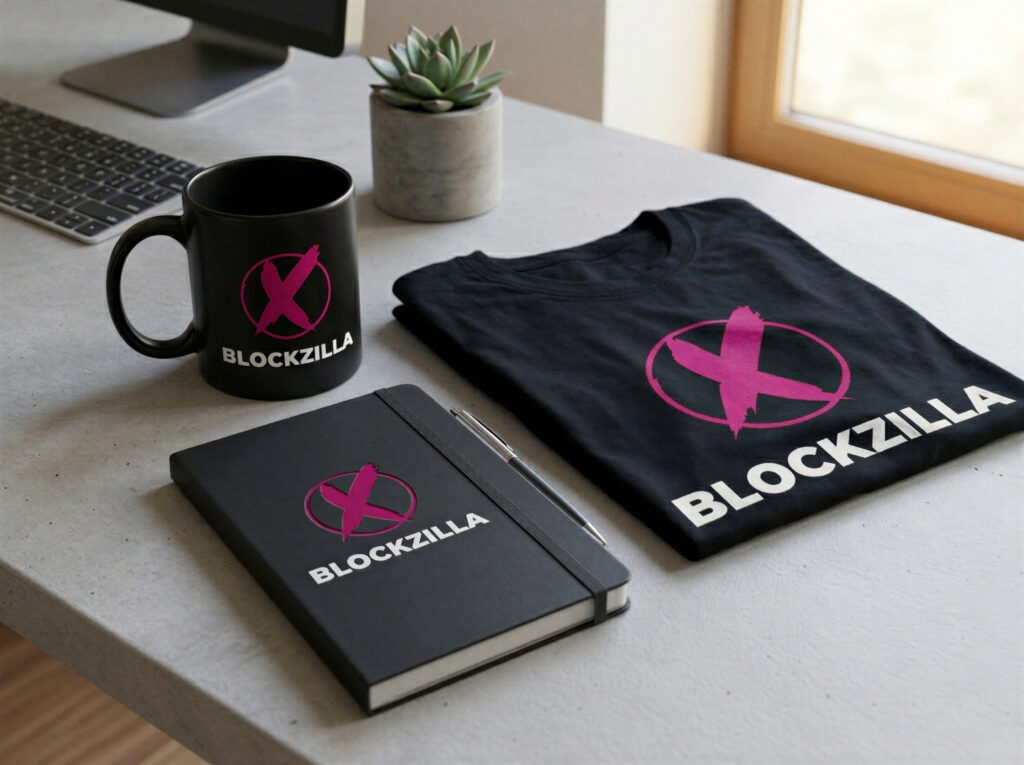
We settled on three items: a t-shirt, a mug, and a notebook. The logic was straightforward - things that live on a desk or get used every day, not novelty items that get appreciated once and then disappear. The mug and notebook in particular are the kind of objects that stay visible. They show up in video calls. They sit on the desk during long work sessions.
The Blockzilla identity prints cleanly on all three. The logo holds up well at the sizes needed for a chest print, a mug wrap, and a notebook cover - consistent enough that the pack felt like a set rather than three separate things thrown together.
The part we did not have to think about
For production, kitting and shipping we used SoMerch. Their catalogue is curated - not a directory of generic suppliers, but a tested selection of products they know and work with regularly. That showed in the outcome: the t-shirt fabric, the mug quality, the notebook cover - everything came back at the standard we were shown upfront.
We submitted one order with all addresses. SoMerch handled production, packed each set into individual boxes, and shipped directly to every team member across Europe. No coordination on our end beyond approving the mockups, which came back the same day. For a team with no operations function, that is the only version of this that is actually sustainable.
What changes when something arrives at your door
The reactions were low-key, which was exactly right. A photo in the group chat. Someone using the mug on a call a few days later. The new team member mentioning it felt like a proper welcome in a way that the onboarding checklist did not.
That is the thing about physical objects in a remote context - they do not need to make a big statement. They just need to arrive. The fact that something was made, packed, and shipped specifically for you lands differently than anything that happens inside a screen.
What we would do next time
Order more upfront. Having a few extra units stored and ready means the next new hire gets the same pack without running a separate order each time. SoMerch handles warehousing for exactly this - stock held and shipped on demand. We will set that up from the start next time rather than treating it as a future improvement.